Developed by AMIC with support from AMPC
The Australian Meat Processor Corporation (AMPC) supports evidence, innovation and continued program development.
 AAWCS2026 annual report
Australian animal welfare assurance
Established in 2013, the Australian Livestock Processing Industry Animal Welfare Certification System (AAWCS) is developed and maintained by the Australian Meat Industry Council (AMIC). It verifies processor systems and animal welfare outcomes from livestock receival through to humane processing.
The AAWCS assurance model
AAWCS is industry-led, but confidence in the program does not depend on an industry claim. Program development, independent administration, government recognition and international benchmarking each provide a different safeguard.
The Australian Meat Processor Corporation (AMPC) supports evidence, innovation and continued program development.
AUS-MEAT independently administers certification, including audit oversight and verification of corrective actions.
The Department of Agriculture, Fisheries and Forestry (DAFF) formally recognises AAWCS within its export animal welfare audit framework.
Independent benchmarking shows where AAWCS aligns with global expectations and where its requirements are stronger.
What the evidence supports
AAWCS gives domestic and international customers a recognised way to verify that animal welfare systems are implemented, monitored and independently assessed.
The AAWCS Standard
The animal welfare Standard underpinning AAWCS defines both the systems establishments must have in place and the outcomes they must demonstrate. Its scope follows the processing pathway—from receival and care to restraint, stunning and humane processing.
Responsibilities, procedures, monitoring, records, internal verification and corrective action.
Competent personnel, suitable facilities and maintained equipment.
Identification and care of weak, ill or injured livestock; handling; restraint; stunning; sticking; and humane killing.
Video surveillance
From 1 January 2026, certified establishments must have a functional video-surveillance system monitoring the full critical handling and slaughter pathway: unloading into lairage; movement from lairage to stunning; restraint and stunning; shackling and hoisting; and sticking.
How the AAWCS Standard evolves
The Standards Review Committee considers scientific evidence, regulation, international guidance and the perspectives of government, animal welfare, technical and industry stakeholders. It recommends changes so the AAWCS Standard continues to reflect current evidence and expectations.
Certification pathway
The AAWCS Standard states what must be achieved. The Program Rules connect implementation, independent assessment, corrective action and ongoing certification into one repeatable system.
Defines the animal welfare systems and outcomes that certified establishments must demonstrate.
Put documented systems into practice across receival, handling, care, restraint, stunning and humane processing.
An independent auditor assesses systems, records, facilities, equipment and animal welfare outcomes.
Findings are addressed within defined timeframes and evidence of completion is verified.
Continuing conformance is confirmed through the program’s certification processes.
Licensed certified establishments may use the AAWCS trade mark as a visible signal of independently assessed conformance.
Annual certification is a cycle, not a one-off claim. Evidence is reassessed, findings must be closed and conformance must be maintained.
The AAWCS trade mark
The registered AAWCS trade mark helps licensed certified establishments communicate their commitment to animal welfare. It signals that their systems have been independently assessed against the AAWCS Standard.
Governance and program integrity
Program ownership, AAWCS Standard review, certification administration and program oversight are separated. Each function contributes a different safeguard to the integrity of AAWCS.
Owns and maintains the AAWCS Standard, oversees the trade mark and engages stakeholders.
Independent, multi-stakeholder review drawing on government, animal welfare, scientific, technical and industry expertise.
Administers certification, manages audit processes and verifies corrective actions.
A national industry committee bringing together technical experts, government representatives and industry stakeholders.
Operating under AMILSC, the sub-committee reviews certification outcomes, program reporting and significant certification matters, supporting program integrity and alignment with regulatory requirements.
2025 program evidence
The year’s results show where certification operates, how participation is changing and what happened when findings were identified.
The 87 certified establishments comprised 76 Meat Processing Establishments, 10 Further Processing Establishments and one Non-Packer Exporter certified as an AAWCS trade mark user.
Long-term growth reflects the wider adoption of independently assessed animal welfare systems across Australian livestock processing.
Source: AUS-MEAT program data.
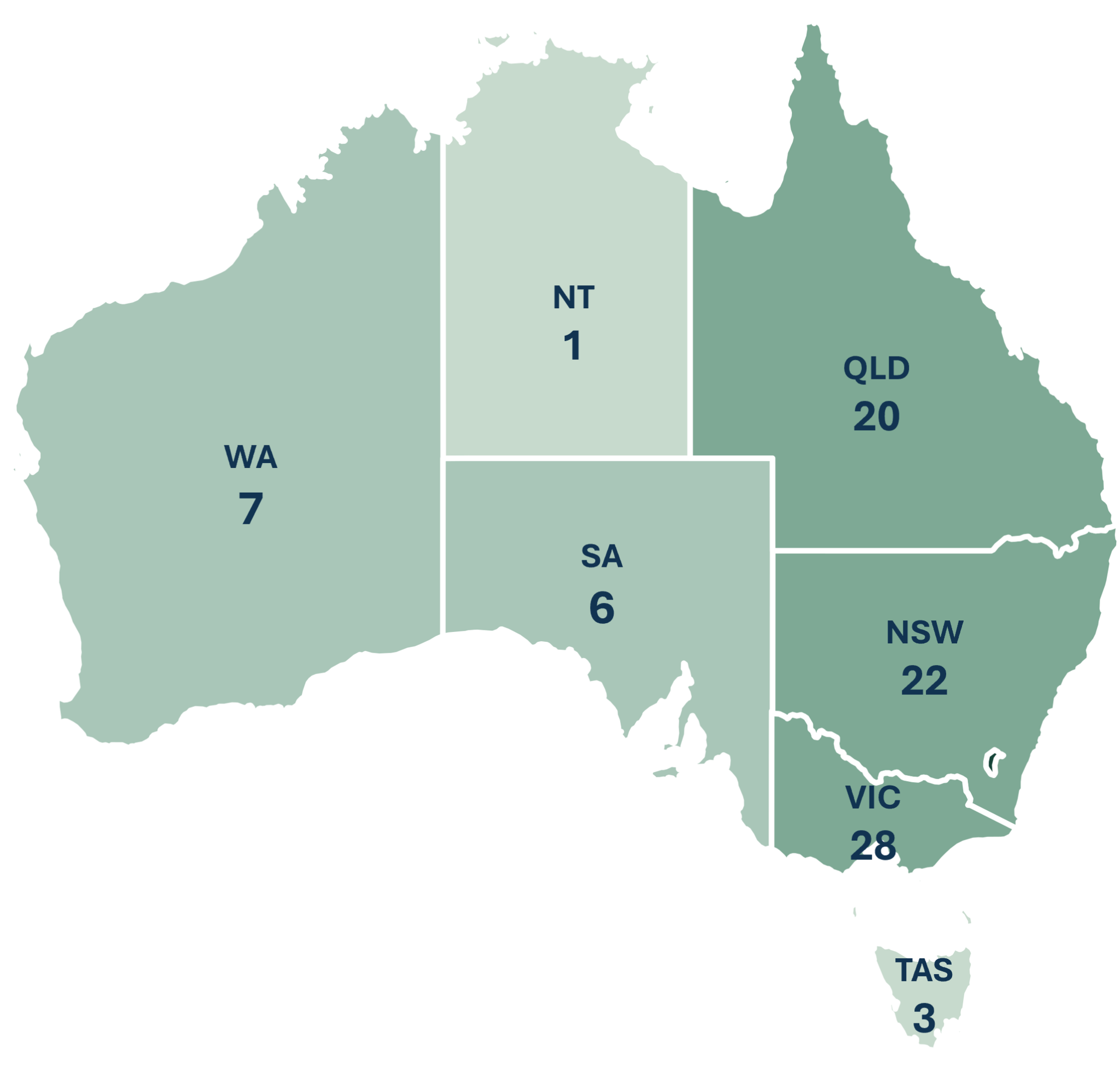
Figures shown for jurisdictions with certified establishments.
Audit transparency
Corrective actions were implemented and verified by AUS-MEAT.
Total recorded across the four sections of the Standard.
All recorded findings were addressed. Corrective actions were implemented and verified by AUS-MEAT. Critical cases were managed through established processes with Certification Sub-Committee oversight.
Industry reach
Program participation translates into substantial coverage of Australian cattle and sheep and lamb processing.
In 2024, certified establishments processed 97.01% of cattle and 92% of sheep and lambs.
Source: Meat & Livestock Australia Limited.
Government and regulatory recognition
DAFF recognises AAWCS within its animal welfare audit framework for export-registered meat processing establishments, consistent with export legislation.
This recognition is supported by the program’s audit, non-conformance and incident-management controls:
Domestic abattoirs in NSW must comply with the AAWCS Standard through their licensing conditions.
International benchmarking
In 2024, an independent project commissioned by AMPC compared AAWCS with the World Organisation for Animal Health (WOAH), North American Meat Institute (NAMI) and RSPCA (UK) animal welfare frameworks. The comparison found that AAWCS aligns with all three on core humane-processing requirements and is stronger in specified assurance controls.
AAWCS requires formal management systems, internal verification, corrective action and annual management review.
Industry experience
AAWCS is an excellent program and should be recognised more broadly as the benchmark for animal welfare.
The company reports that certification has supported continuous improvement, staff awareness and capability, and its reputation in domestic and export markets.
Research and development
AMPC-supported projects are examining technologies and practical opportunities relevant to animal welfare monitoring and management.
AMPC-supported work includes international benchmarking, the Edition 5 review and practical resources for consistent implementation.
Assessment of high-frequency electrical stunning for cattle to improve animal welfare outcomes during processing.
Research is assessing artificial intelligence and machine learning as tools to strengthen animal welfare monitoring and management decisions.
Challenges and opportunities
Keep the AAWCS Standard aligned with science, regulation, industry practice and stakeholder expectations.
Use evidence and emerging technology to strengthen monitoring, decisions and welfare outcomes.
Use transparent results and independent benchmarking to build confidence with customers, government and international markets.
Program information
Contact AMIC about certification, customer assurance, government engagement or the continued development of AAWCS.